How to Choose the Best Multi Cooker Pot for Wholesale?
Choosing the right multi cooker pot for wholesale requires more than comparing prices and advertised wattage. Buyers need evidence about demand, durability, safety features, and after-sales support. Grand View Research reports that the global smart kitchen appliances market is expanding rapidly, driven by convenience, connected functions, and smaller household sizes. Meanwhile, Allied Market Research identifies pressure cooking and multifunctionality as important demand factors in the broader cooker market.
The opportunity is real.
Robert Wang, founder of Instant Brands, once said, “The Instant Pot is designed to make cooking easier and more convenient.” His statement reflects the core wholesale value: one appliance can replace several countertop tools. However, convenience alone should not decide a purchase. A reliable multi cooker pot should offer clear controls, stable temperature performance, a durable inner bowl, secure locking, and replacement parts that remain available. In a busy retail warehouse, weak handles or poorly printed markings become costly complaints.
Product testing should include rice, soup, steamed vegetables, and slow-cooked meat. These tests reveal uneven heating, seal problems, and confusing presets. They also expose an uncomfortable truth: impressive packaging cannot repair inconsistent performance. Some buyers may prefer a low-cost model, but repeated returns can erase the original margin.
When comparing suppliers, wholesalers should request laboratory reports, sample units, warranty terms, carton specifications, and documented compliance information. Energy use also matters. The International Energy Agency continues to highlight efficiency as a major factor in appliance ownership costs. A thoughtful sourcing decision balances purchase price with reliability, usability, and long-term customer trust. No single model wins every market. That is worth remembering.
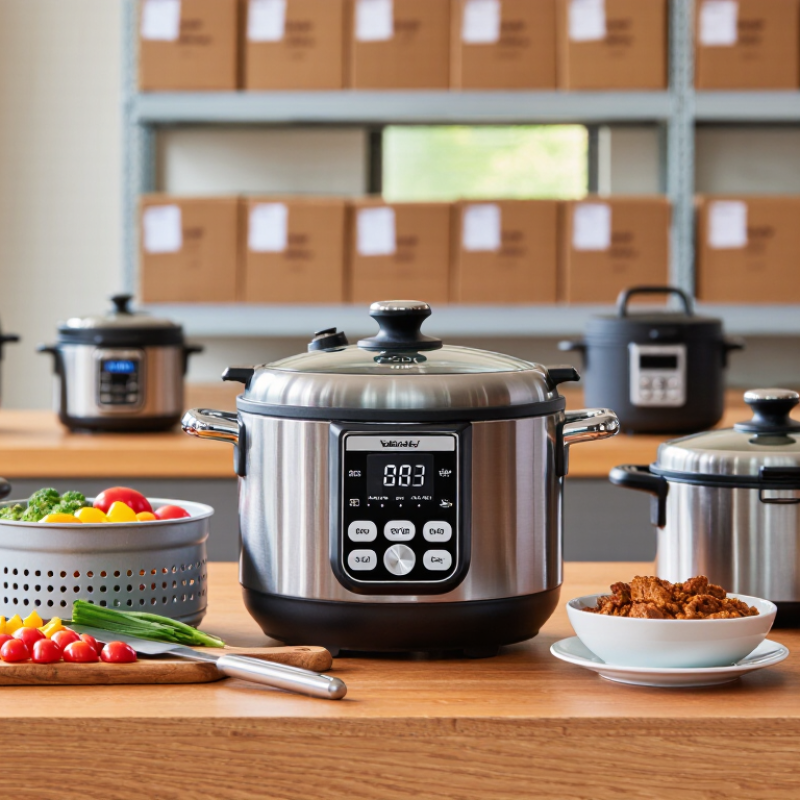
Define Wholesale Requirements: Capacity, Voltage, MOQ, and Target Price
How to Choose the Best Multi Cooker Pot for Wholesale?
Wholesale buying starts with clear requirements, not attractive product photos. Capacity should match your customer’s daily cooking habits. A 3-liter pot may suit small households, while a 6-liter model works better for family meals. Check the inner pot size, usable volume, carton dimensions, and shipping weight. These details affect both storage and freight costs. My first quotation request missed carton measurements. That mistake increased the estimated delivery cost.
Voltage must fit the destination market and household sockets. Confirm voltage, frequency, plug type, heating power, and safety documentation before sampling. A mismatch can cause returns, delays, or unsafe use. Ask for test reports and product specifications in writing. Keep the requirements simple. Record every detail in one purchasing sheet.
Tips: Set a realistic MOQ before negotiation. A low MOQ may raise the unit price, but it reduces inventory risk. Compare pricing at several quantities, such as 100, 500, and 1,000 units. Include packaging, inspection, spare parts, and shipping in the target price. Do not choose the cheapest offer too quickly. A lower price may hide thinner materials or weaker temperature control. I still review these assumptions because sales forecasts are rarely perfect.
Compare 4–8 L Capacities and 700–1,500 W Power Ratings
For wholesale buyers, capacity and wattage should be evaluated together. A 4 L cooker suits small households, while 6 L offers a practical balance for shared kitchens. An 8 L model supports batch cooking, but its carton size and shipping weight increase. Grand View Research valued the global electric pressure cooker market at approximately USD 5.1 billion in 2023, with continued growth expected through 2030. This suggests broad demand, but not every capacity fits every market.
Power changes cooking speed and operating cost. A 700 W unit usually heats more slowly, yet it may suit smaller 4 L bowls and lower-voltage regions. A 1,000–1,200 W model gives steadier heating for 6 L cooking. A 1,500 W model can recover heat faster after cold ingredients enter the pot. At 230 V, that equals about 6.5 amps. Check local electrical requirements.
Do not judge by wattage alone. Test water-heating time, temperature recovery, lid sealing, and handle strength before placing a large order. The IEC 60335-2-15 safety standard covers household appliances for heating liquids, including relevant construction and protection requirements. I would request laboratory evidence, not only supplier claims. One limitation remains: higher power may improve speed, but it can increase packaging warnings, plug requirements, and user confusion. A sample test often reveals this.
How to Choose the Best Multi Cooker Pot for Wholesale? - Compare 4–8 L Capacities and 700–1,500 W Power Ratings
Generic reference configurations for wholesale product selection; final specifications should be confirmed through product testing and electrical compliance checks.
| Reference Configuration |
Rated Capacity |
Rated Power |
Power-to-Capacity Ratio |
Approximate 250 ml Servings |
Recommended User Group |
Typical Functional Positioning |
Wholesale Selection Notes |
| Compact Entry Model |
4 L |
700 W |
175 W/L |
Up to 16 servings |
1–3 people |
Rice, soup, steaming, slow cooking and basic pressure cooking |
Lower carton weight and shipping cost; suitable for small households, compact kitchens and entry-level retail channels. |
| Compact Plus Model |
5 L |
900 W |
180 W/L |
Up to 20 servings |
2–4 people |
General-purpose cooking with a practical balance between capacity and countertop footprint |
Common mid-size configuration for broad-market distribution; verify lid design, removable parts and packaging protection. |
| Family Standard Model |
6 L |
1,000 W |
167 W/L |
Up to 24 servings |
3–5 people |
Family meals, batch cooking, stews, beans, grains and steaming |
Strong all-round wholesale option; check usable fill markings because the rated vessel capacity is not always the maximum safe cooking fill. |
| Family Plus Model |
7 L |
1,200 W |
171 W/L |
Up to 28 servings |
4–6 people |
Larger batch cooking for families, meal preparation and small gatherings |
Offers more volume without reaching the largest footprint; confirm handle strength, inner-pot durability and shipping dimensions. |
| Large-Capacity Model |
8 L |
1,500 W |
188 W/L |
Up to 32 servings |
5–8 people |
Large batch cooking, catering-style preparation and high-volume household use |
Higher output and capacity, but requires more shelf space, stronger packaging and careful review of plug, circuit and certification requirements. |
Calculation note: Approximate serving counts are based on the rated vessel volume divided by 250 ml. Actual usable capacity is lower for many cooking functions because manufacturers commonly specify a maximum safe fill level, especially for pressure cooking and foods that expand or foam. Power-to-capacity ratios are calculated from the rated wattage and rated capacity.
Check Pressure Performance Against the Common 10–15 psi Range
How to Choose the Best Multi Cooker Pot for Wholesale?
Check Pressure Performance Against the Common 10–15 psi Range
Pressure performance should be your first wholesale checkpoint. The USDA Complete Guide to Home Canning identifies 10 and 15 psi as common reference pressures for pressure processing. However, a multi cooker is not automatically a pressure canner. Its operating profile needs separate verification.
Ask suppliers for test records from calibrated pressure equipment. Check performance at 10, 12, and 15 psi. Record the time required to reach each level. A stable cooker should hold pressure without large swings, excessive steam, or repeated valve movement. Small details matter. Watch the gasket after repeated cycles. Inspect the valve seat, locking pin, and pressure-release path.
The National Center for Home Food Preservation highlights altitude adjustments for pressure processing. This matters for wholesale distribution across different regions. A cooker calibrated at sea level may perform differently in high-altitude warehouses. Request test results at multiple ambient conditions, if available. Also compare readings from the display with an independent pressure gauge. Digital numbers can look precise. They may still be wrong.
For batch approval, test several units from different production lots. One sample is not enough. I would reject any model with unclear pressure tolerances or incomplete records. That may reduce short-term margins, but returns cost more. A practical review should include 100-cycle testing, seal inspection, and pressure recovery after opening. The weak point is often the seal, not the heating element. I have seen specifications look excellent until repeated-use testing exposed inconsistent pressure control.
Verify IEC 60335-2-15, UL 1026, and Food-Contact Compliance
When selecting a multi cooker pot for wholesale, compliance should guide your decision. Start by requesting test reports for IEC 60335-2-15 and UL 1026. These standards address electrical safety, heating performance, insulation, abnormal operation, and construction quality. The applicable standard may depend on the destination market. Do not rely on a supplier’s product label alone.
Ask for reports issued by an independent, competent laboratory. Check the exact model number, rated voltage, factory address, and test date. A report for a similar cooker is not enough. Inspect the power cord, plug, lid lock, steam valve, and thermal protection during sample evaluation. In real purchasing projects, small design changes can invalidate earlier test results. That detail is easy to miss.
Tips: Request food-contact declarations for the inner pot, sealing ring, steam pathway, and accessories. Confirm the material composition and applicable limits for your sales region. Look for evidence supporting FDA requirements, EU food-contact rules, or other local regulations. The cooking surface should resist peeling, odor transfer, and corrosion after repeated heating. Test several samples, not just one. Keep written records. A certificate proves testing, not every future production batch. Manufacturers should also provide batch controls, inspection procedures, and corrective-action records. If documentation seems incomplete, pause the order and ask specific questions. A lower price is not a safety strategy.
Assess Safety, Warranty, Defect Rates, and FDA’s 57°C Hot-Holding Rule
How to Choose the Best Multi Cooker Pot for Wholesale?
Safety should be checked before price. The FDA Food Code 2022 requires hot-held food to stay at 57°C (135°F) or above. Ask suppliers for temperature-mapping records, not only marketing claims. Test several units with a calibrated probe. Check the center, edge, and surface after two hours. Small differences matter.
The CDC estimates that foodborne illness causes about 48 million illnesses, 128,000 hospitalizations, and 3,000 deaths yearly in the United States. This makes stable heating and clear controls essential for commercial buyers. Review insulation, lid seals, overheat protection, grounding, and cleaning access. A difficult seal can trap rice, grease, and moisture. It may pass inspection today, but fail in daily use.
Defect rates deserve written evidence. Request first-year failure data, sample sizes, repair records, and the exact inspection method. A claimed “low defect rate” means little without numbers. Warranty terms should cover parts, labor, shipping, and response times. The 2023 ASQ Quality 4.0 research highlights the value of data-driven quality control, yet supplier data can still be incomplete. I would order a small pilot batch first. Wholesale decisions are rarely perfect. Track heating failures, damaged lids, and returned units for 30 days before scaling.